
BLOG: Getting to know oil paints
September 20, 2026
Author: Laure Cazals (CNRS)
Co-author: Loïc Bertrand (ENS Saclay)
Introduction
The spatial and chemical heterogeneity of heritage materials make imaging an essential tool for evaluating conservation treatments. When planning an experiment, a large number of experimental parameters are defined, such as beam size, acquisition time, and the wavelengths of illumination and detection. The latter are crucial to optimise image contrast. Visible-light photography, which captures the image across three channels (red, green and blue), is widely used to document heritage objects for its similarity with human vision.
However, contrast can be greatly enhanced by illuminating the object at a specific wavelength (for example, a varnish emits intense blue light when excited under UV, which allows it to be distinguished from unvarnished areas). Detecting the signal at specific wavelengths allows further improvement of the contrast. The choice of illumination and detection wavelengths is generally based on an assumed composition of the object. Once one or several images have been captured, the data are processed to link the data collected to the sample composition.
This work explores how systematic optimisation of acquisition parameters can maximise the information obtained from imaging experiments while reducing acquisition time and, where relevant, radiation exposure.
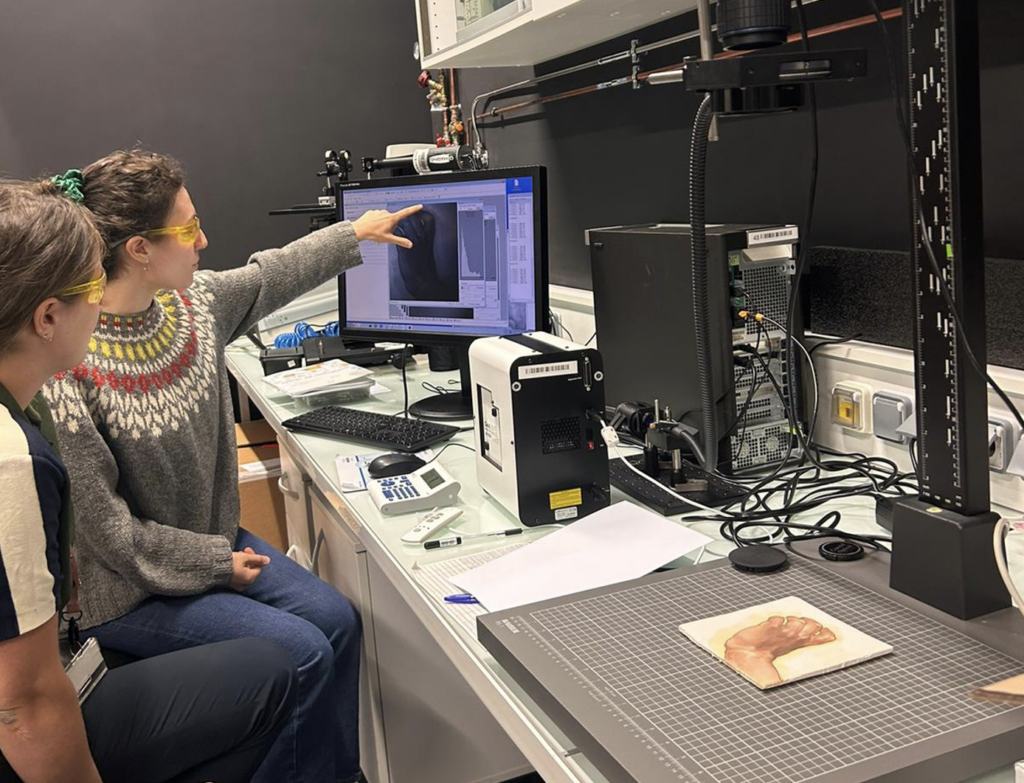
Figure 1: Experimental session at IPANEMA, Saint-Aubin, France. Multispectral macro-imaging set-up developed in-house by Mathieu Thoury. Credits: Clara Nabet.
Imaging protocol
As part of the GoGreen project, we developed an imaging protocol to assess the efficiency of varnish cleaning using electrospun tissues developed by the University of Bologna (for more information, read the article here). Drawing on varnish specific fluorescence properties under UV light, we conducted an experiment at appropriate illumination and detection wavelengths. We acquired an image of several areas cleaned using tissues with different design parameters in order to compare their cleaning efficiency. Using appropriate modelling, we show that the varnish thickness can be derived from the fluorescence signal. Mapping the distribution of varnish residues and their thickness allows for a quantitative assessment of varnish removal. The presence of varnish residues, even of very low thickness, is a key question today with the developments of new carriers (tissues, gels) used in the cleaning of artworks.
We then designed a decision-support tool, which can be used to assess the compatibility of illumination and detection wavelengths with a view to obtaining a varnish thickness map from data collected from the surface of the paint. This tool enables the optimal selection of wavelengths, thereby reducing the number of images to be acquired and, consequently, the time required to study an object, which in turn means that more systems can be studied during a single imaging session.
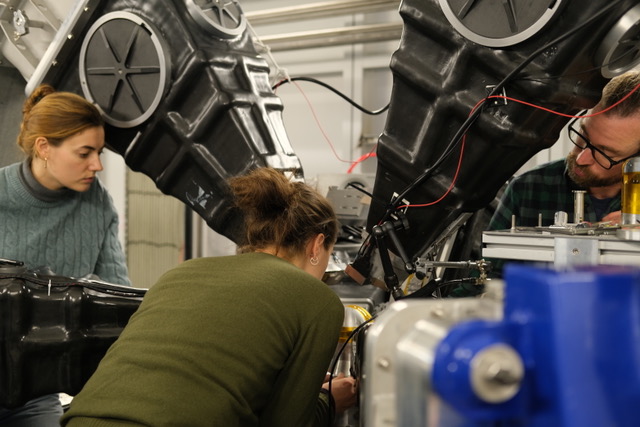
Figure 2: Experimental session at the ID20 beamline, ESRF, Grenoble, France. X-ray Raman scattering spectroscopy and imaging set-up. Credits: Loïc Bertrand.
This approach has been further expanded to various stages of an experimental session (acquisition parameters, noise, data processing, etc.). For example, we extended this strategy to X-ray Raman scattering, a highly photon-demanding synchrotron technique that could not be applied to radiation-sensitive samples. By selecting a limited number of wavelengths that retained the information required to distinguish the relevant chemical components, we substantially reduced the acquisition time and therefore the accumulated radiation dose, enabling measurements on a radiation-sensitive paint stratigraphy. These results were published in a recent issue of the journal Science Advances.
Next steps
The GoGreen project will end in a few days, but we would be very happy to hear from researchers, conservators and other stakeholders interested in these approaches. Please do not hesitate to comment or to contact us with questions or requests for further information.