BLOG: GoGreen Academy: From the Lab to the Wider Conservation Community
September 18, 2026
BLOG: Optimising imaging experiments for conservation research
September 28, 2026
Author: Sander van Lith (UvA)
Introduction
Since the beginning of the GoGreen project, I have carried out research to better understand the chemistry of an oil paint as part of Work Package 2. In particular, I want to understand which factors are most harmful in an oil paint during aging, and how this damage can be minimized in the future using climate control.
Throughout this exciting learning journey, I have studied how humidity can contribute to molecular changes in an oil paint’s lifetime and how this would affect its macroscale properties e.g. its mechanical properties. Since we are approaching the end of the four year program, I believe it is time to write about my experience of my PhD journey.
First impression
At the start of the consortium, I was (and still am) excited about my research topic. However, as my internal knowledge database about the topic piled up, I have to admit that identifying new subtleties in an oil paint, and obtaining relevant insights were challenging. The research output of the cultural heritage community has substantially grown over the last decade and thus a deep-dive in literature was first required.
If you realize that an oil painting consists of multiple layers with their own distinct material characteristics, you will quickly imagine that understanding the synergistic effects of the layers with its surrounding environment becomes a complex, mind-boggling task. So during the course of the project, it was important for me to narrow down the scope of my main project(s) to address the most relevant knowledge gaps within the fixed time of the project.
The start of the journey
A substantial part of my PhD has focused on the effect of humidity on the oil paint chemistry in which I generally use infrared spectroscopy as main characterization method. Before carrying out that line of research, I still remember the early days of my PhD: Alongside literature review, I have spent many days on method development in order to detect spatially-resolved chemical changes in an oil paint, to refine my own research questions and methods. Much of the next phase of my PhD was spent with measuring aged oil paint mock-ups using ATR-FTIR (see figure 1). This method was relatively quick and allowed me to examine the chemical changes across a large sample set of different oil paints.
As the project progressed, the research became increasingly data-heavy and desk-based. You also have to process all the data you acquired throughout your PhD.
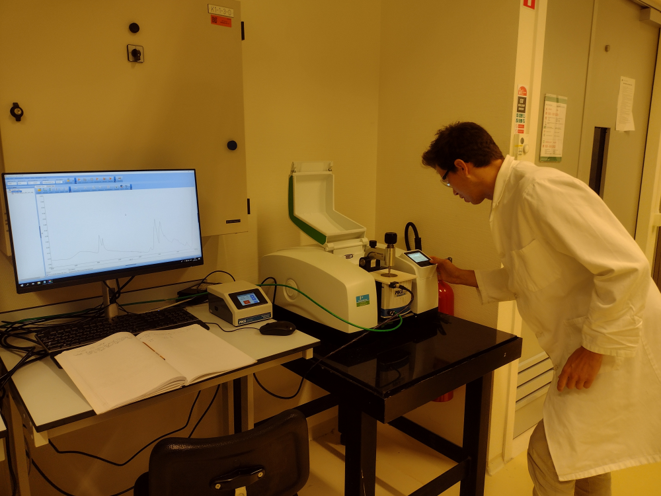
Figure 1: I am measuring spectra of aging oil paints with the ATR-FTIR apparatus at our institute (HIMS, UvA).
My research in a nutshell
Since oil paints are complex materials, my research uses simplified oil paints (mock-ups). In a nutshell, my ongoing work on chartering the climate response of an oil paint towards its surrounding environment, have two things in common:
1) I have a well-controlled and documented mock-up with standardized thicknesses and composition, and
2) I control the environment of those mock-up using an oven and some environmental chambers.
The result is usually a well-curated and documented sample set ready to be analyzed. You can see an example of such sample set in the photo below. This was also an important lesson from my PhD. Good science often starts before a measurement. I have to consistently label my samples, record the aging conditions, and knowing exactly what happened to every mock-up during its lifetime. This will allow to observe more subtle differences in future data-analysis attempts which are induced by its surrounding environment.
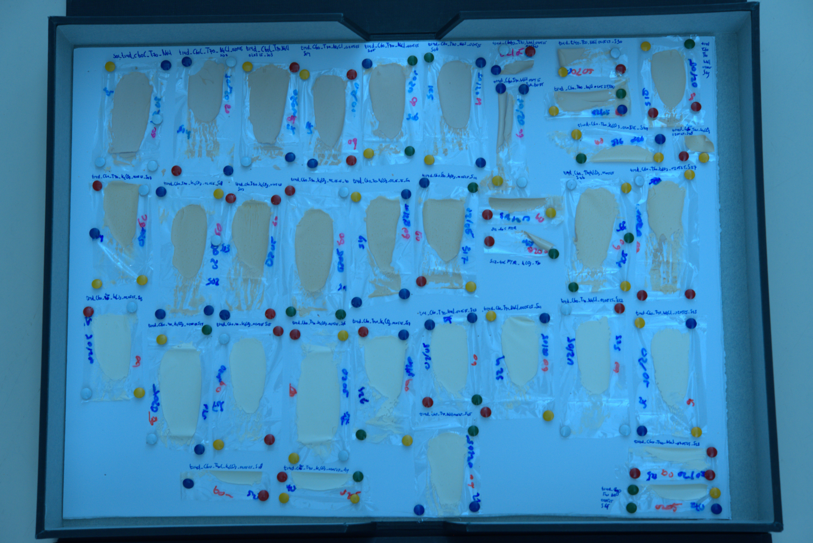
Figure 2: A snapshot of different aged lead white oil paints which were prepared. The transcripts in blue indicated the labels describing each specific aging condition.
Is it really that simple?
When I sometimes hear myself write or speak about my own work, I wonder if my work sounds monotonic. I study the material by preparing different samples, adjust a few parameters, and just analyze the results. In practice, interpreting data and thinking of relevant research questions requires some critical thinking from my side.
Sometimes, apparent differences between results were just a matter of measurement conditions e.g. wrong alignment or climate differences. Continually questioning the data, method and own assumption during the project has been challenging, but also the most rewarding part of the project. It helped me to improve my next experiment and find new research questions.
Future steps
As the GoGreen project is approaching its end, it is time wrap-up. I am currently working on finalizing my latest findings. I am looking forward to share those with you in the near-future!